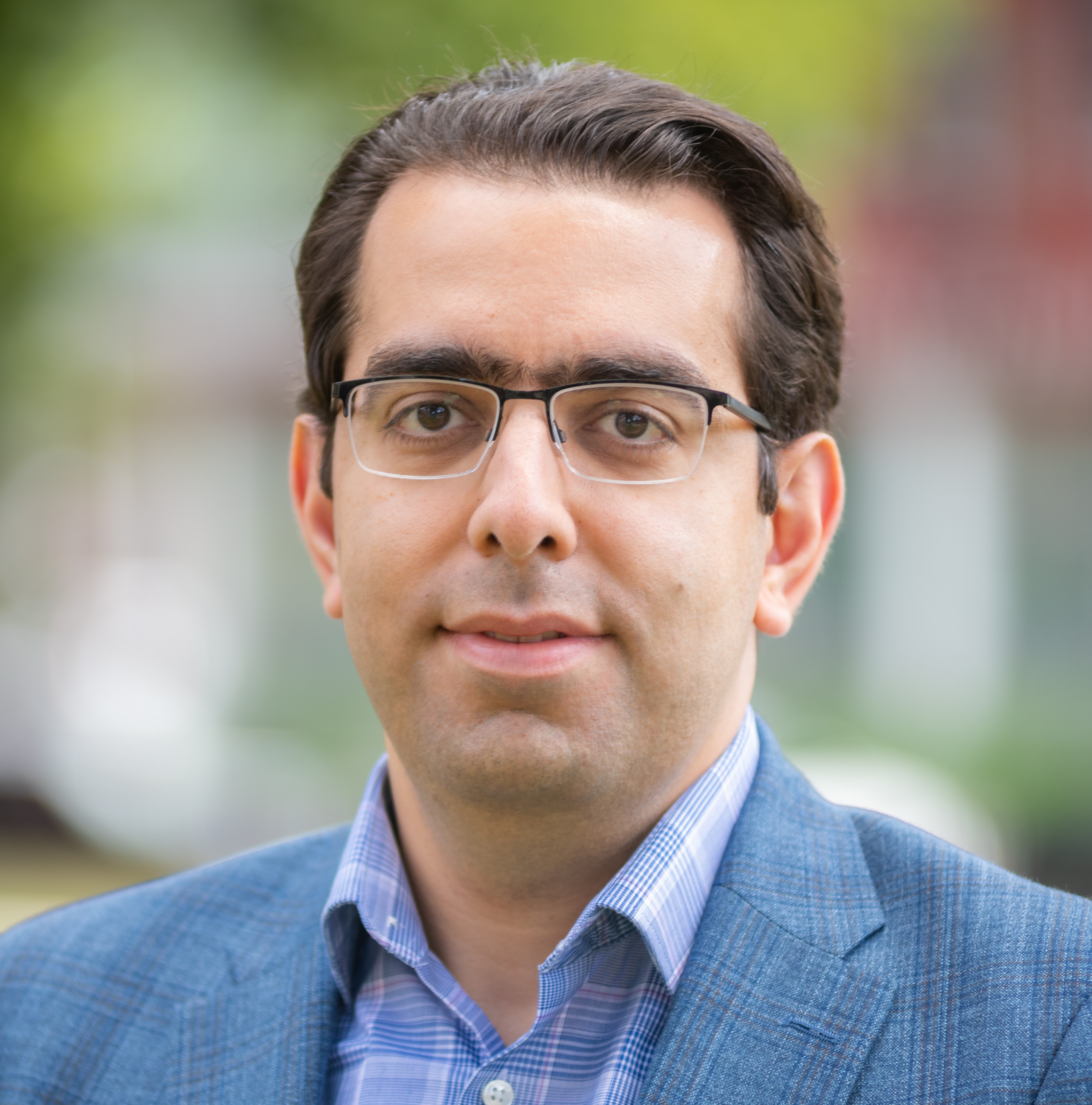
Hamed Alemohammad
I am an Associate Professor in the Graduate School of Geography at Clark University and Director of the Clark Center for Geospatial Analytics (CGA). My work sits at the intersection of Earth observation, geospatial analytics, and artificial intelligence, with a focus on building data‑driven methods that help us better understand—and make decisions about—a changing planet.
My research is motivated by a simple question: how can we turn the growing volume of Earth observation data into reliable, actionable understanding of environmental systems? I approach this problem by combining machine learning with geospatial and physical insight, paying particular attention to uncertainty, model evaluation, and real‑world applicability.
In recent years, my group has been focused on the development, evaluation, and benchmarking of self-supervised learning models for Earth observation, and specifically generalizable foundation models designed to learn from heterogeneous geospatial data at scale. You can find updates and related work here.
Research Themes
My research spans methods, theory, and applications across geospatial AI, including:
- Geospatial AI and machine learning for Earth observation, with an emphasis on scalable and generalizable models
- Evaluation and uncertainty characterization in geospatial and remote sensing ML systems
- Synthetic aperture radar (SAR)–based retrievals of soil moisture and vegetation properties
- Foundation models and benchmarking for multisensor Earth observation data
Biography
Hamed Alemohammad is an Associate Professor in the Graduate School of Geography and Director of the Center for Geospatial Analytics at Clark University. He is an interdisciplinary scientist with expertise in remote sensing, Earth system science, and geospatial artificial intelligence. His research focuses on developing and evaluating data‑driven methods for extracting information from Earth observation data, with a particular interest in uncertainty, model robustness, and the responsible use of AI in geospatial applications. He has served as Principal Investigator on multiple projects developing novel machine learning approaches for multispectral, microwave, and synthetic aperture radar (SAR) observations, and his recent work centers on geospatial foundation models for Earth observation. As Director of CGA, he leads research programs, external partnerships, and workforce development initiatives, working across academia, government, industry, and international organizations to translate geospatial research into practice.
Previous Experience
Before joining Clark University in January 2023, I was the Chief Data Scientist and Executive Director at the Radiant Earth Foundation. Radiant Earth’s mission is to advance open data, open standards, and shared infrastructure for geospatial machine learning, particularly in support of global development and sustainability challenges.
At Radiant Earth, I established and led the development of Radiant MLHub (now Source Cooperative), an open‑access repository for geospatial training data and machine learning models, and helped convene the global geospatial community around standards and best practices for interoperable data ecosystems, including the SpatioTemporal Asset Catalog (STAC).
Previously, I was a Postdoctoral Research Scientist at Columbia University’s Department of Earth and Environmental Engineering, working with Pierre Gentine. My research focused on land–atmosphere interactions and on developing remote sensing–based retrievals to study coupled water, carbon, and energy cycle processes.
Before Columbia, I was a Postdoctoral Research Associate at MIT in the Department of Civil and Environmental Engineering, working with Dara Entekhabi in the Parsons Laboratory for Environmental Science and Engineering. There, I developed polarimetric retrieval algorithms for NASA JPL’s AirMOSS mission to estimate soil and vegetation parameters from P‑band SAR observations.
I received my Ph.D. in Civil and Environmental Engineering from MIT in 2014 (supervisors: Prof. Dara Entekhabi and Prof. Dennis McLaughlin). My doctoral research focused on quantifying uncertainty in remotely sensed precipitation estimates, developing ensemble‑based methods to propagate spatial uncertainty into ecohydrological, meteorological, and data assimilation models.